The shared war
After launch, every player's war feeds one shared front. You never fight another player directly, but what they do shapes the ground you fight on.
The shared war comes after launch. Shellfall ships first as a single-player game, built so that the shared war can be added later as an update or an Early Access phase.
All players fight in one persistent war. Your army's progress is local; the war's progress is shared. What you achieve in the sectors within your gun's reach adds pressure to the front for your faction, and every other player sees where the front has moved.
Two layers
| Layer | Who shares it | What it holds | How fast it changes |
|---|---|---|---|
| Your war | Just you | Your gun, your recon, the sectors in your reach in full detail | Seconds to minutes |
| The global war | Every player | Front lines per sector, the rail network, ruins and big destruction, faction intel | Once every 10 minutes |
You never fight another player directly. The enemy soldiers in your reach are run by the game, but where they stand, which rails they have and what is already in ruins all come from the global war, and so from what the other side's players have done.
What you achieve shows at once around your gun. Your successes there, such as a destroyed depot, a finished dig or a stopped charge, are reported a few times a minute, and contributions are checked. At the next update the front moves, combined with everyone else's work.
How the front moves
Each sector counts the pressure from each side's successes over the last two hours or so. The front moves by the difference, and never faster than a set cap.
| In a sector | The front |
|---|---|
| Both sides active, about as successful | Holds |
| Both active, one clearly more successful | Moves toward the weaker side, faster for a bigger gap |
| Three players on one side, one on the other | Moves slowly toward the smaller side; a lone defender slows it but cannot hold it forever |
| Only one side playing | Moves at a slow, capped rate; it never jumps |
| The side that pushed stops playing | Stays where it reached; nothing slides back |
| Nobody playing | Frozen |
Three things stop one side running away with the war. The further an attacker gets from its newest rail line, the less each success is worth until engineers lay new track (see The rail network). Sectors near a faction's main line and depots get a defence bonus. A faction with fewer active players gets higher rewards and a pressure bonus, so joining the weaker side pays.
What you see
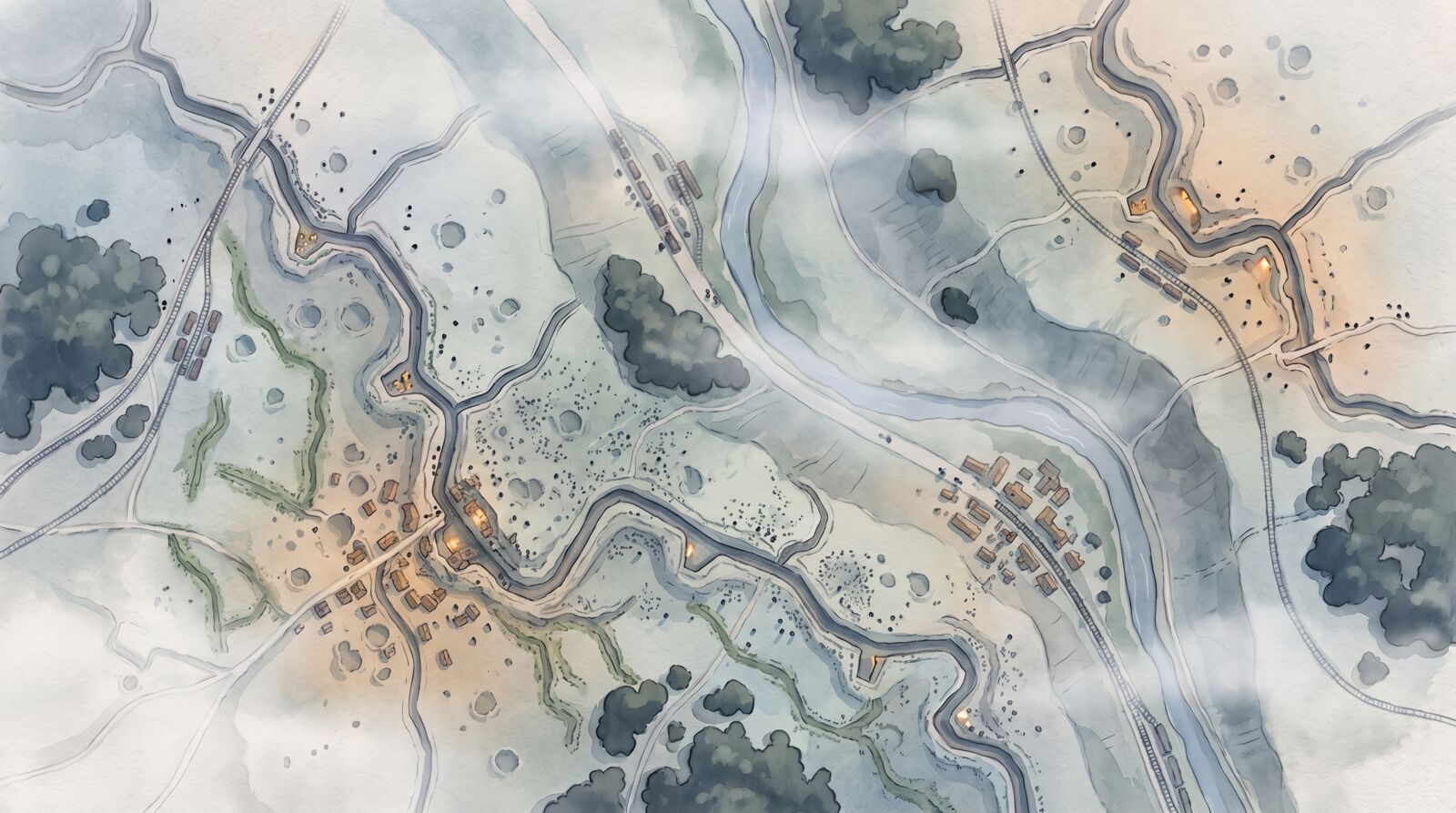
- The war map. The whole valley: fronts, recent movement, how many gunners fight where, and the state of the rails.
- Choosing where to fight. You drive. Pick a siding and the route goes around any line the front has cut. Or, when you start, report straight to The hot zone, where contributions count double.
- Arriving. The ground around you streams in from the shared state. Nothing reloads; clouds and Fog of war hide what is still being built.
- Shared intel. Your faction's recon feeds one shared last-known layer, so a depot one player destroyed shows as ruins for everyone on that side. See The intel map remembers.
If other players' pushes take a place with one of your operations, your story branches as usual. See Operations and requests.
Single player, same war
The same systems run offline. In the campaign, the story drives the front. In Valley Mode, simulated gunners on both sides push it. See The campaign: four seasons and One continuous war.