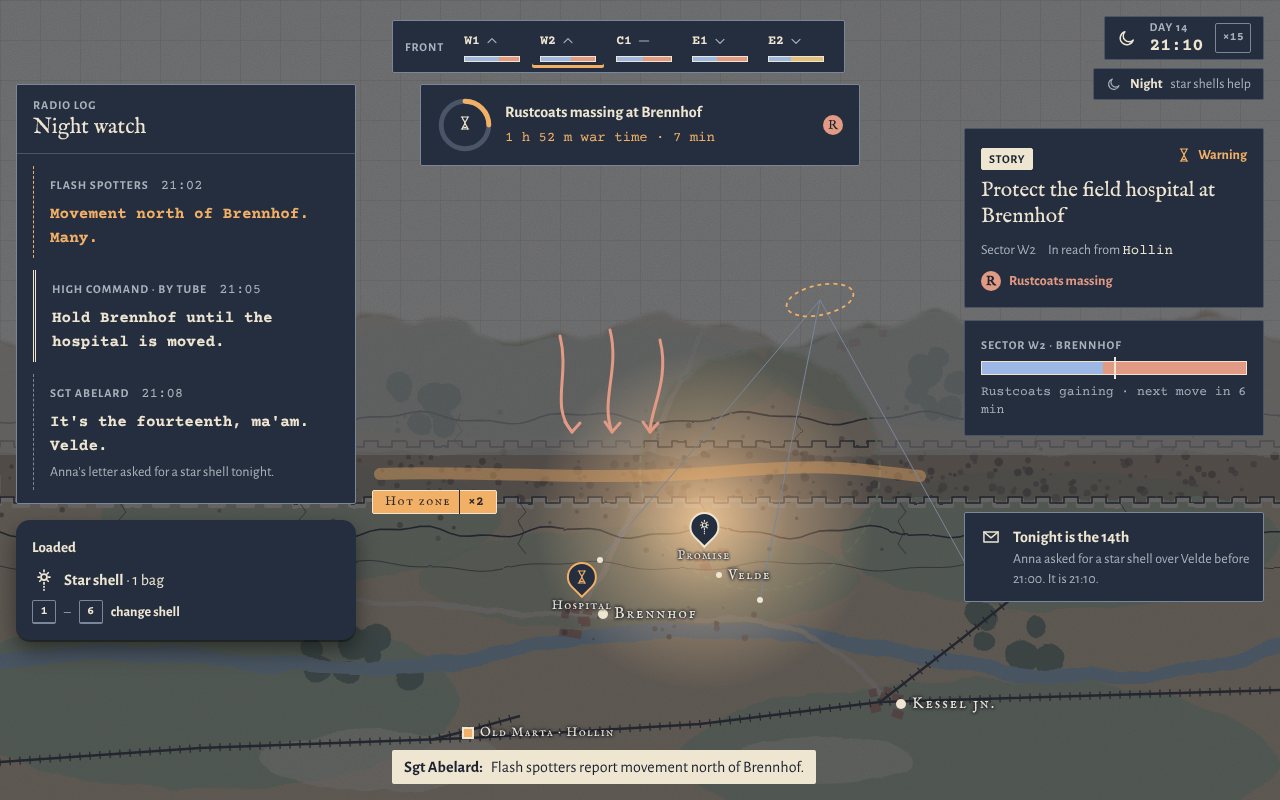
Light up the sky on the 14th so my son can see it. He is in the line at Velde and he writes that the nights are very dark there.
Anna Halloran
Asks for: a star shell over VeldeBefore 14 Nov, 21:00
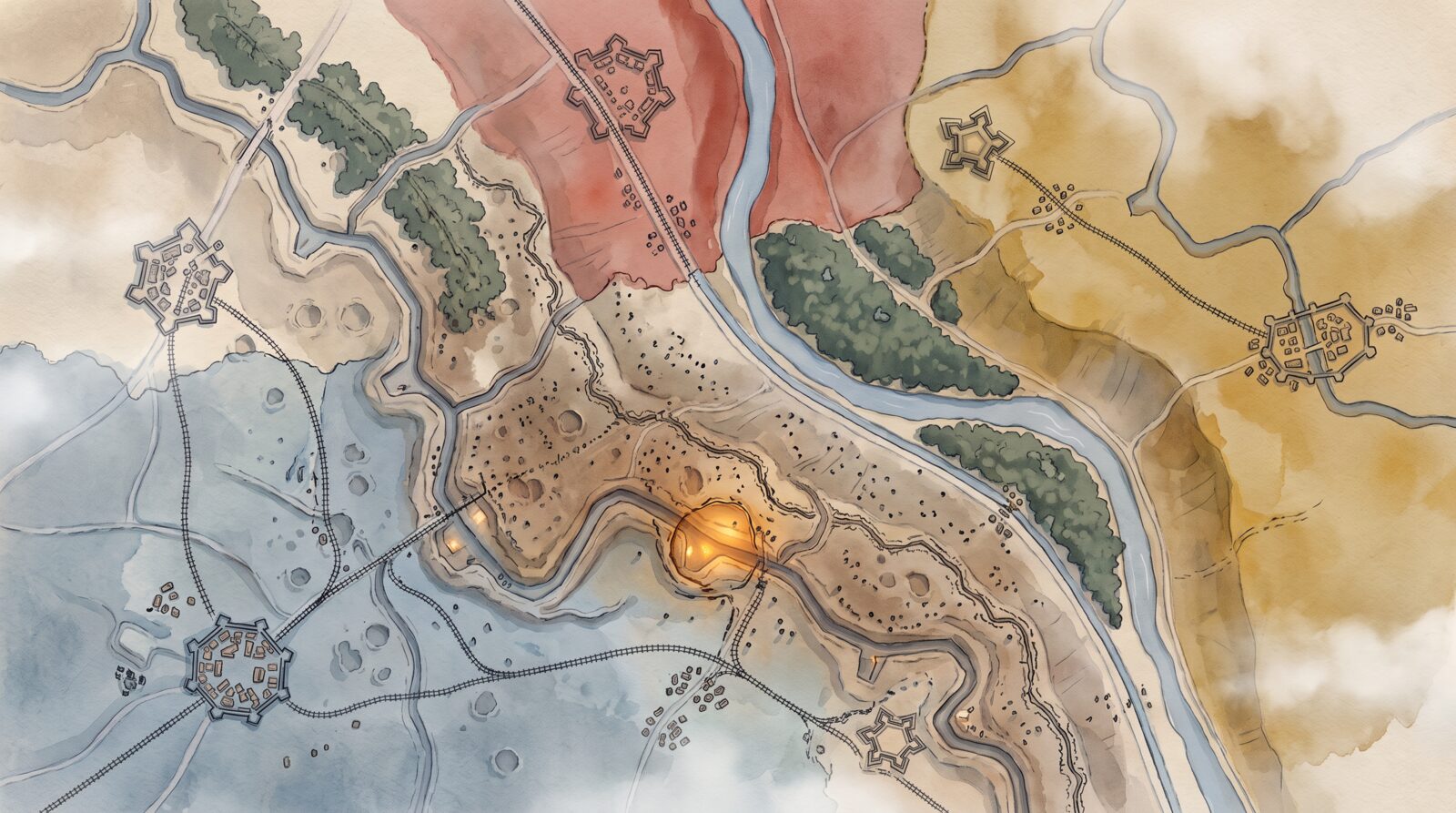
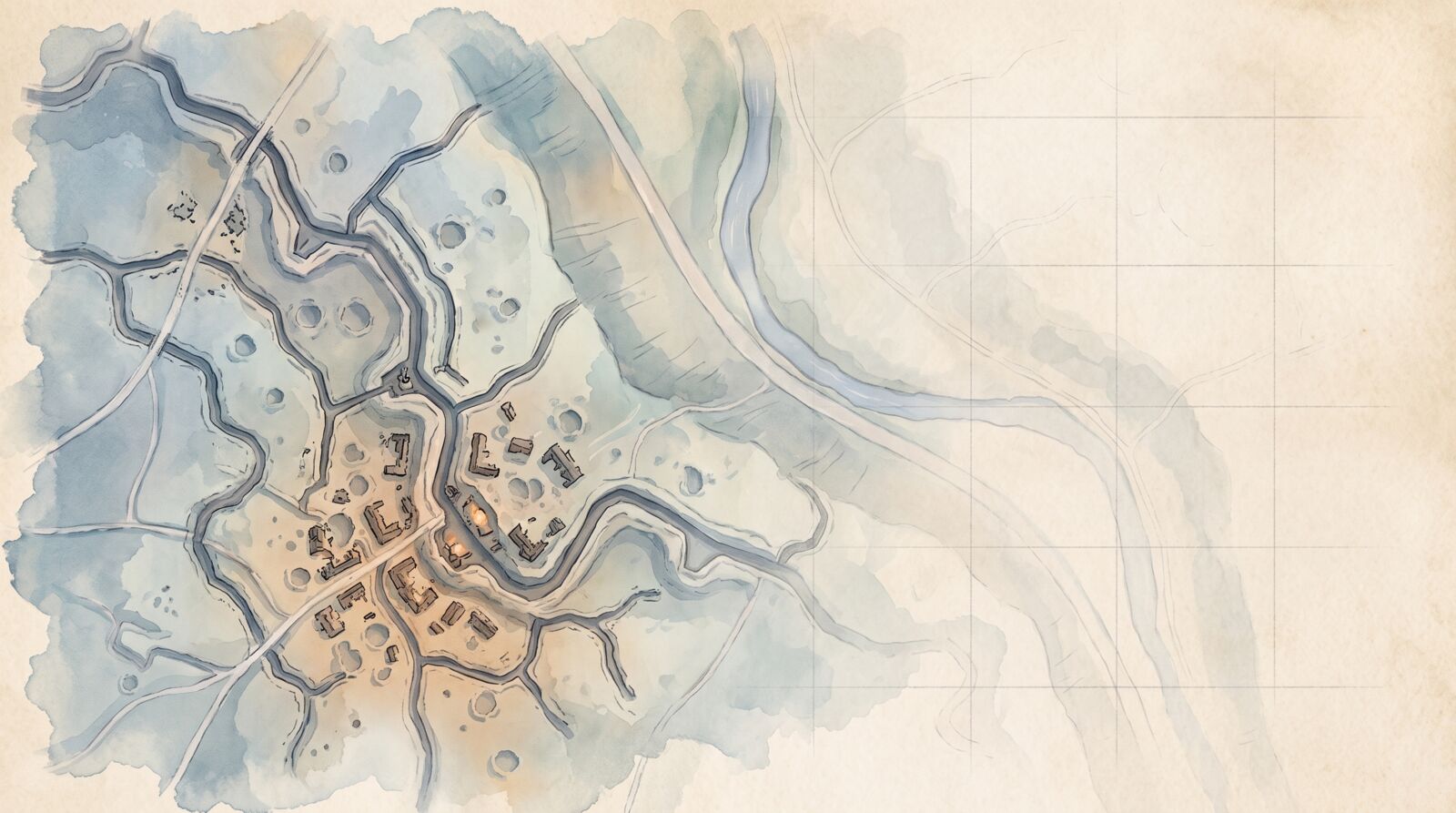
Concept map of the Lowmarch. Move across it to fly the recon plane.
You command Old Marta, a railway gun far behind the lines. The war is out of sight: you see it only through recon, painted on a watercolour map table. Every careful shot lets your side dig a little further forward.
The Steam page opens later in development
I'm the old gunner on the hill. I can't win the war alone, but every careful shot I make lets my side dig a little further forward.
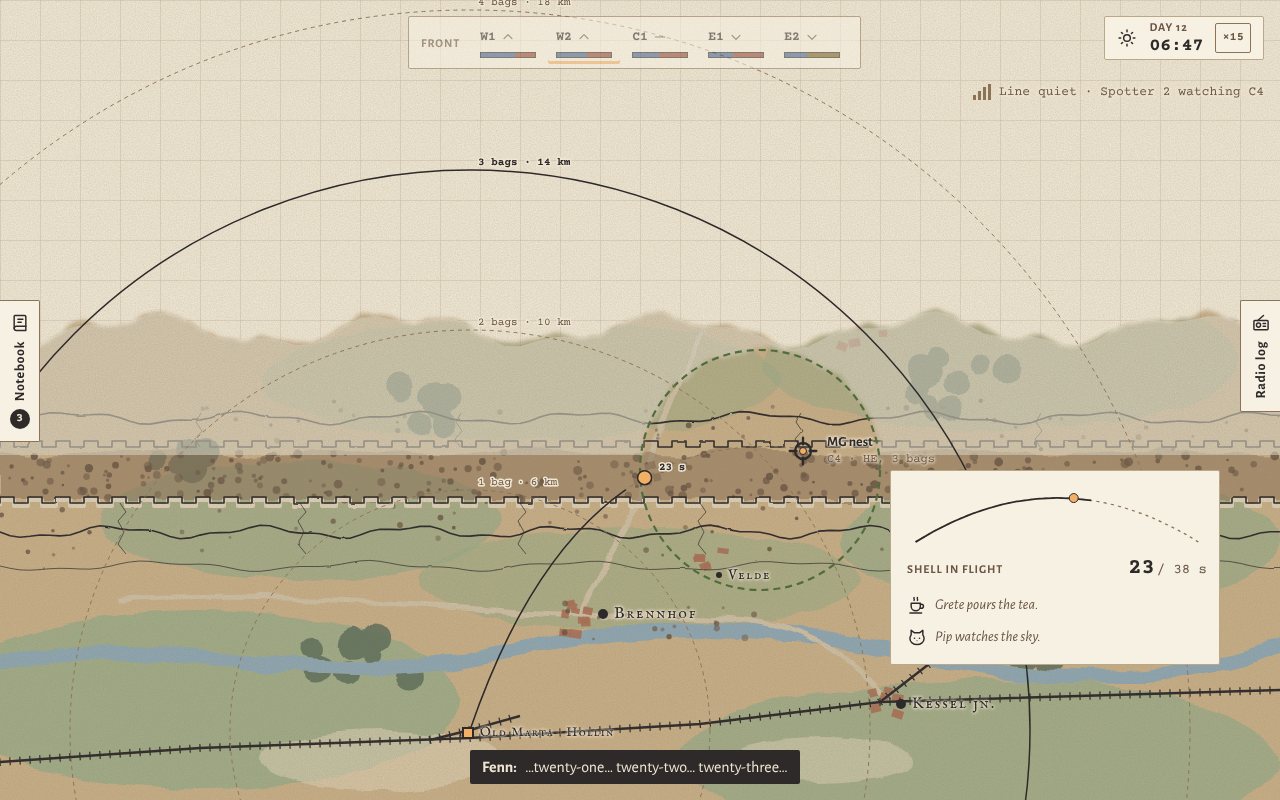
Find a target through recon. Read its bearing and range on the map table and look up the elevation in the firing table. Turn the heavy barrel, pick a shell and how many powder bags to load, then pull the lanyard. The shell flies for most of a minute while the crew pours tea. Then a spotter radios where it landed, and you correct.
Add 50, left 20.
Fenn: one turn up, a notch left.
| Charge | Max range | Flight | Spread |
|---|---|---|---|
| 1 bag | 6 km | 25 s | 40 × 15 m |
| 2 bags | 10 km | 35 s | 70 × 25 m |
| 3 bags | 14 km | 45 s | 110 × 35 m |
| 4 bags | 18 km | 60 s | 160 × 50 m |
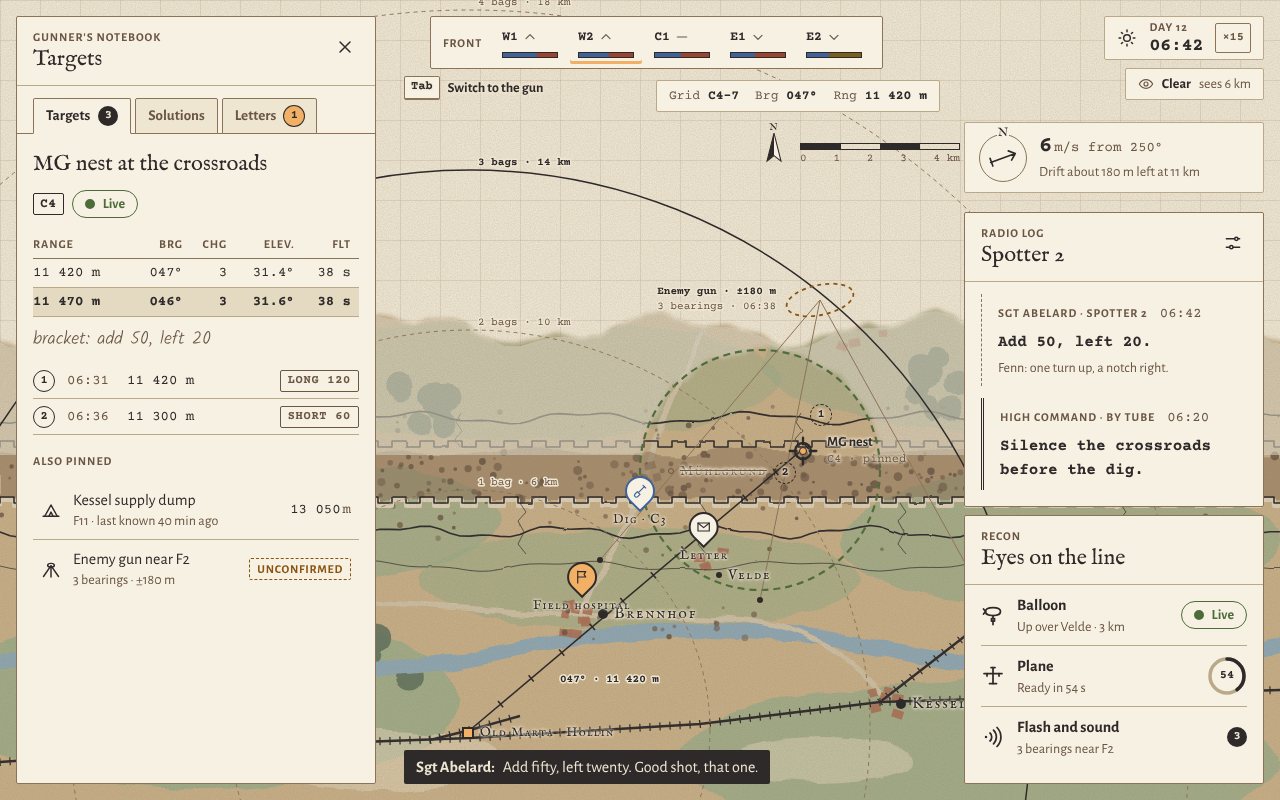
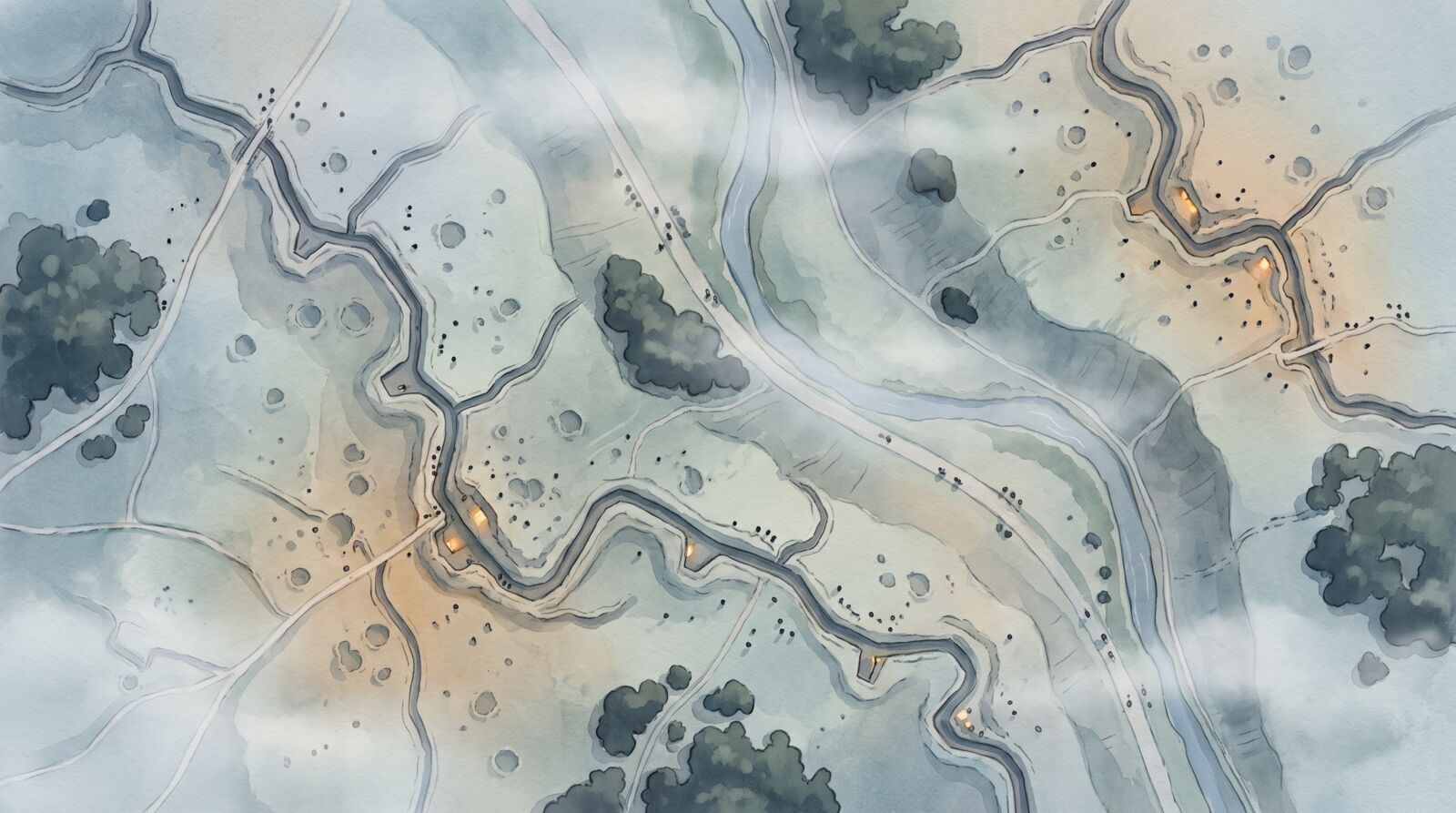
The front is 4 to 15 km away and out of sight. Unknown ground is blank paper with a pencil survey grid. Spotters, an observation balloon and recon planes paint it in, and what they saw stays on the map, fading as it ages, until someone looks again.
Your shells fall into that fog. Only the impact report tells you what you hit, and what you destroyed stays ruined on the map until recon shows otherwise.
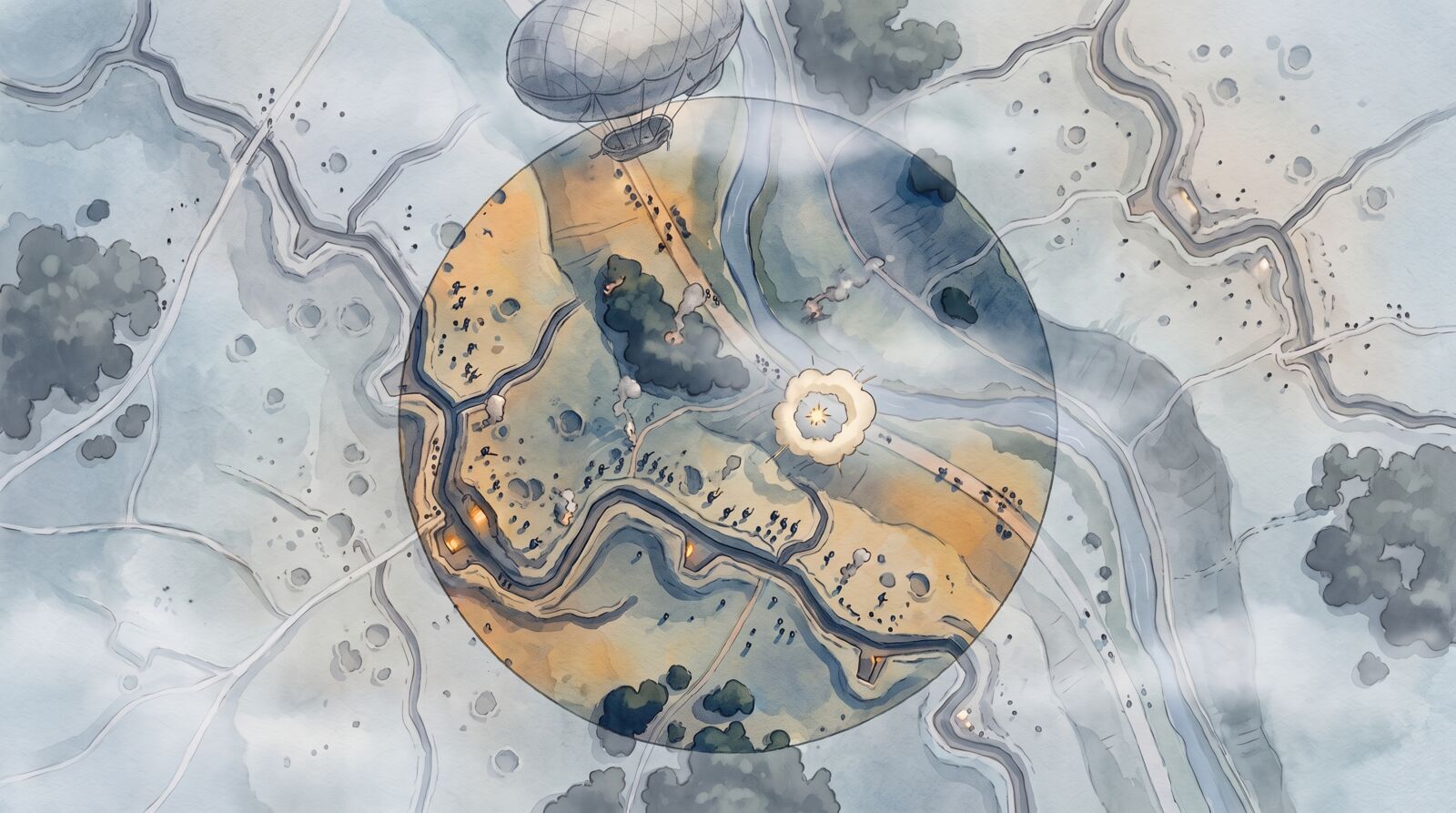
Heavy shells stamp real craters into the ground, and the rain fills them. Trench bays cave in under direct hits, breaches invite a charge, and abandoned lines slump, flood and grow over with grass. They never simply vanish.
Your side can only dig forward where you have made it safe to dig: smoke to hide the sappers, shrapnel to keep the enemy's heads down. Over a war, the valley becomes a record of everything that happened in it.
Cover our dig at grid C4.
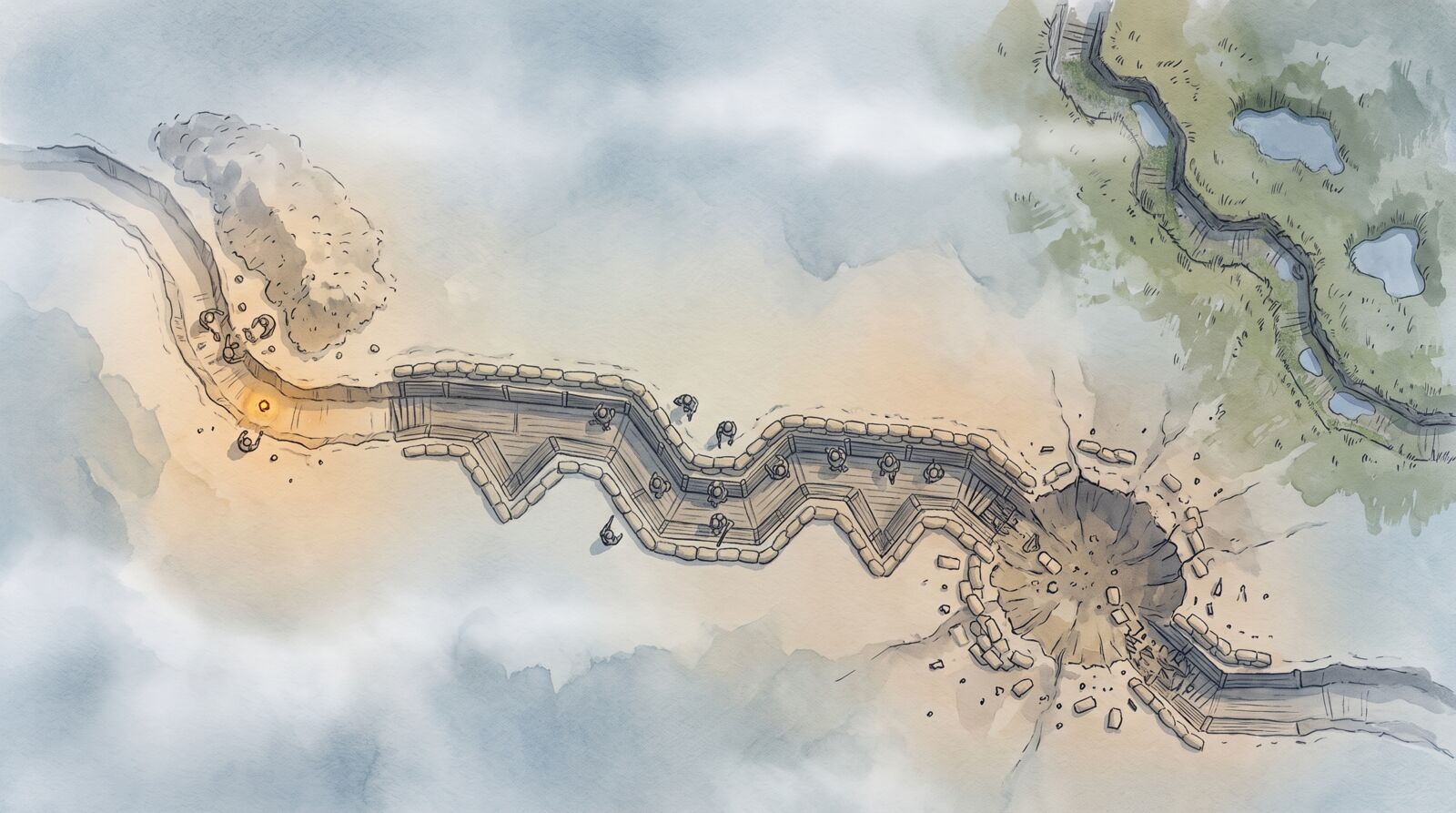
Old Marta is a heavy railway gun that spent twenty years rusting in a museum depot. Each shot gives her away a little. Once the enemy's flash-spotters and sound-rangers have two or three good bearings, ranging shots start to fall on the yard, wide at first, then closer.
So you limber up, roll along the rails to another siding and emplace again. From there every bearing and range is new, and the solutions in your notebook are stale until you work them out again.
They have two bearings. Move soon.
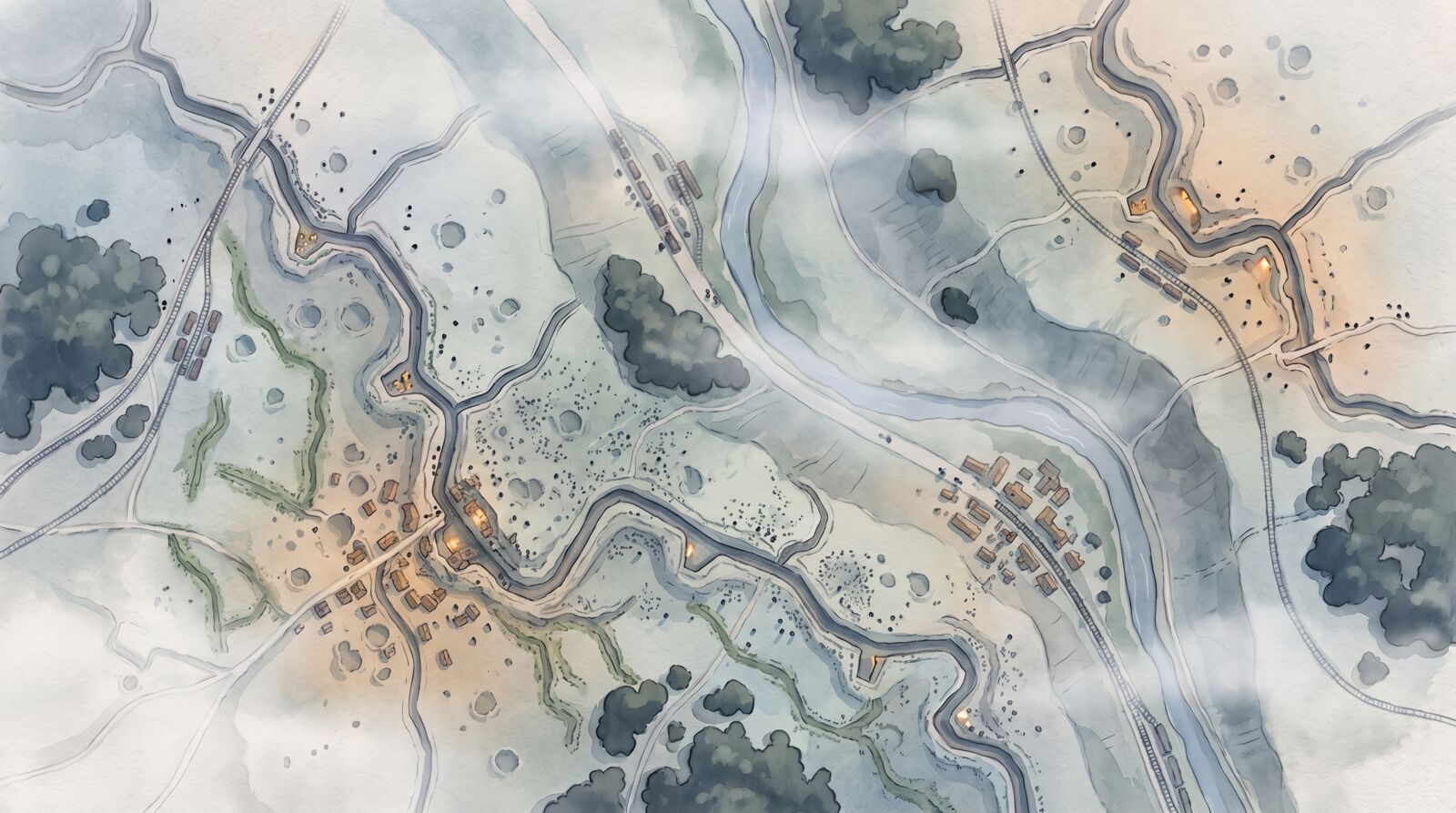
The Lowmarch is a lowland valley of farms, canals, forests and walled towns, fought over by three armies. It is one continuous war. Where Old Marta stands on the rail network decides which stretch of front her guns can reach, and the rest of the front fights on without you.
Pick a siding on the map and the train takes you there. Stay west to finish a dig, and the line may break in the east.
Orders come by radio and pneumatic tube. Letters from villagers, soldiers and your own family wait at the sidings you pass, and some of them ask for something: spare an orchard, light the sky on a certain night. You can keep those promises, or miss them for good.
When a place with an open story operation falls while you are elsewhere, the story does not end. It branches, and the ruins stay on the map.
Light up the sky on the 14th so my son can see it. He is in the line at Velde and he writes that the nights are very dark there.
Anna Halloran
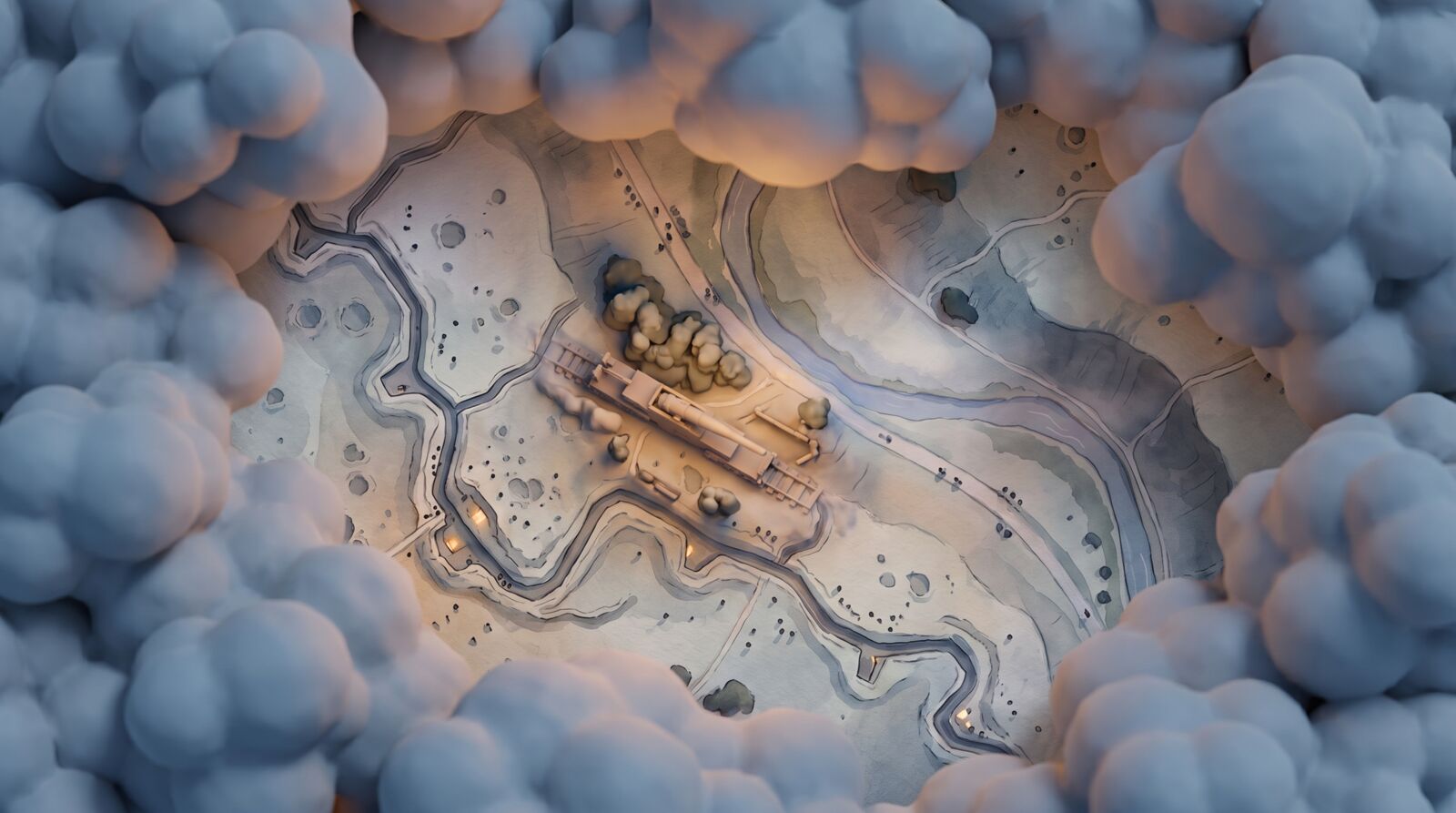
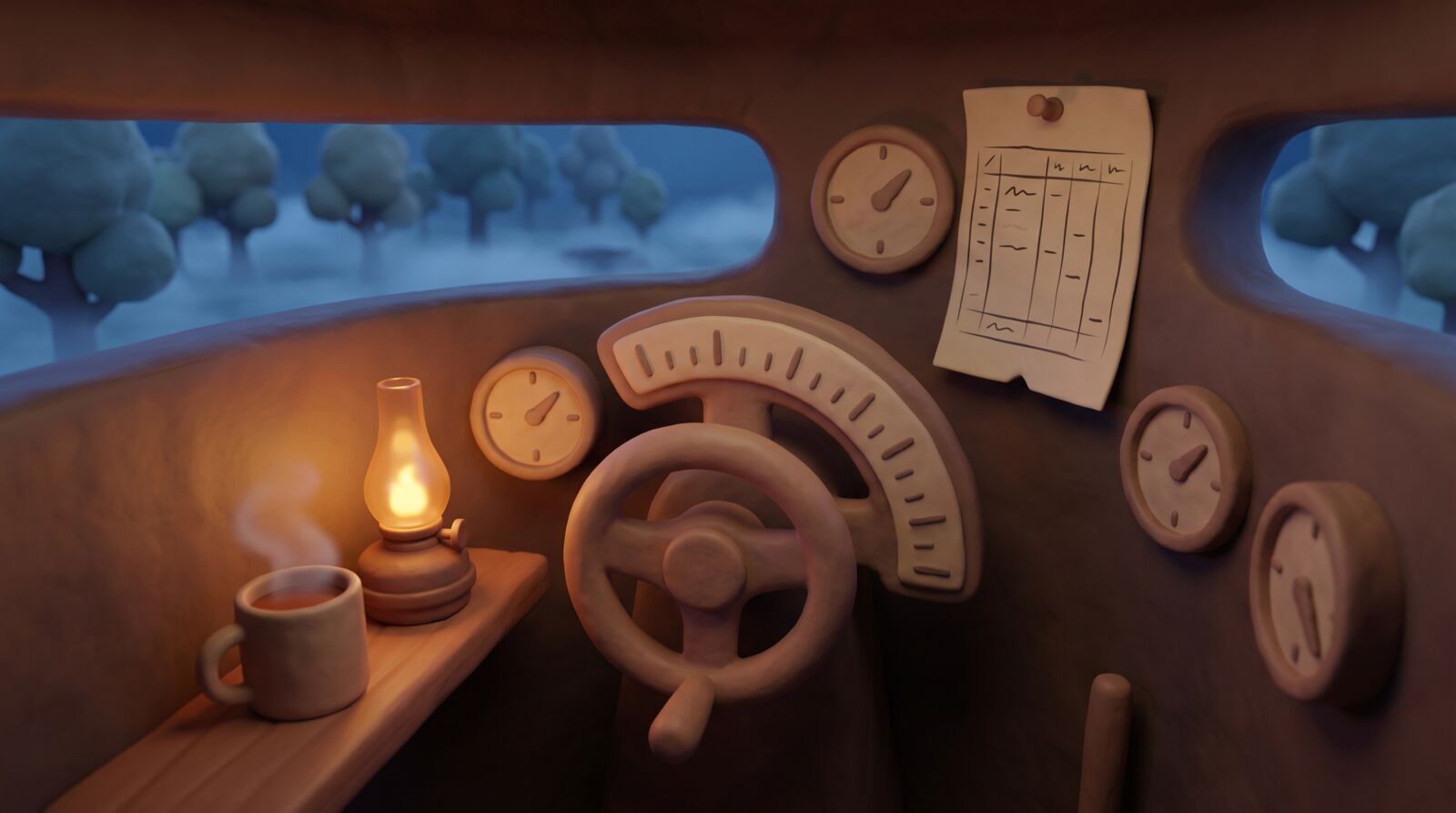
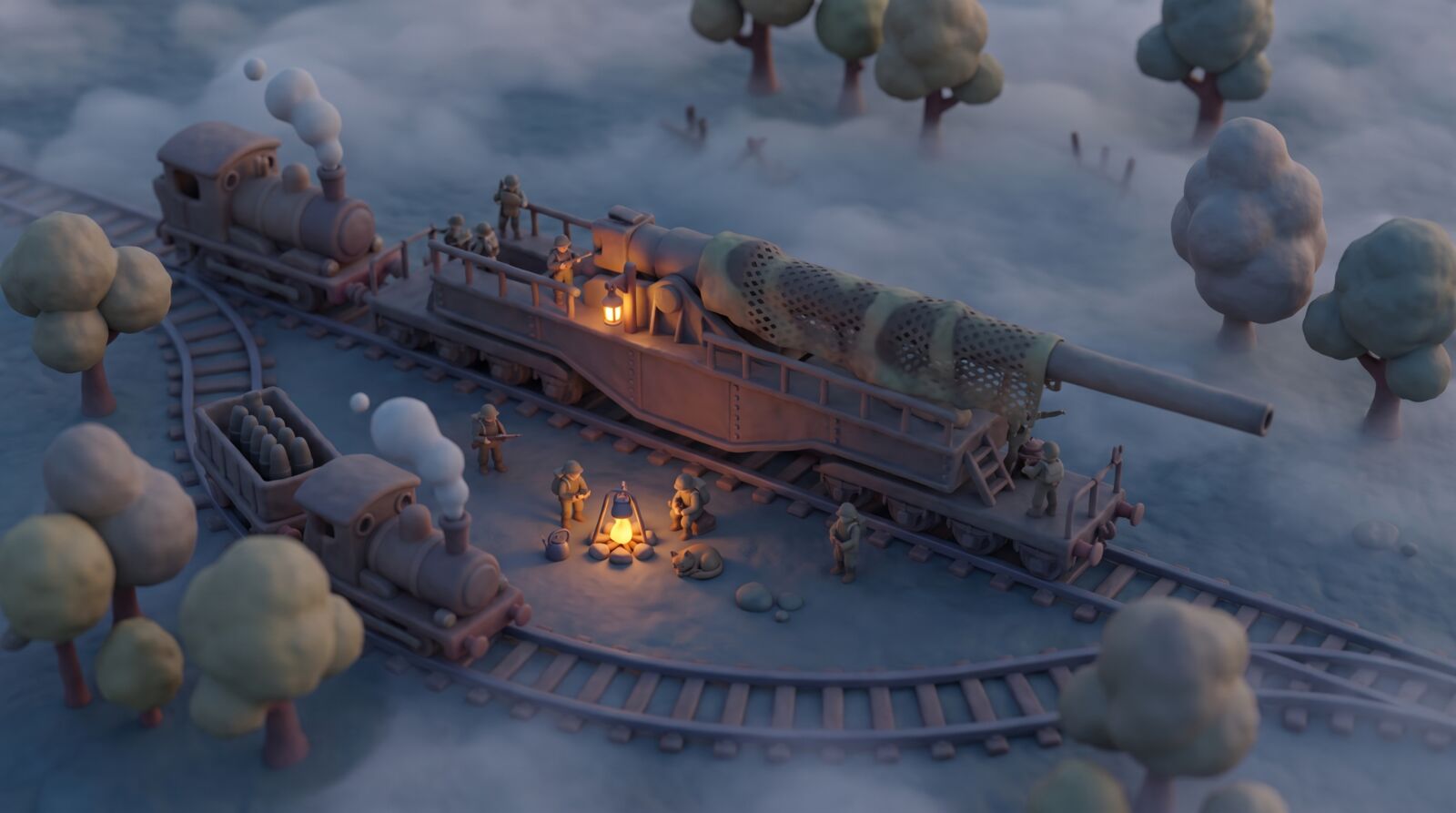
The war is a soft watercolour and ink painting, seen from high above: tiny soldiers, crater stipple, trenches drawn as ink lines. The only close-up is the gun. Zoom onto Old Marta and you drop through a band of clouds into a matte clay gun yard, warm lamps in blue fog, and on into her cockpit.
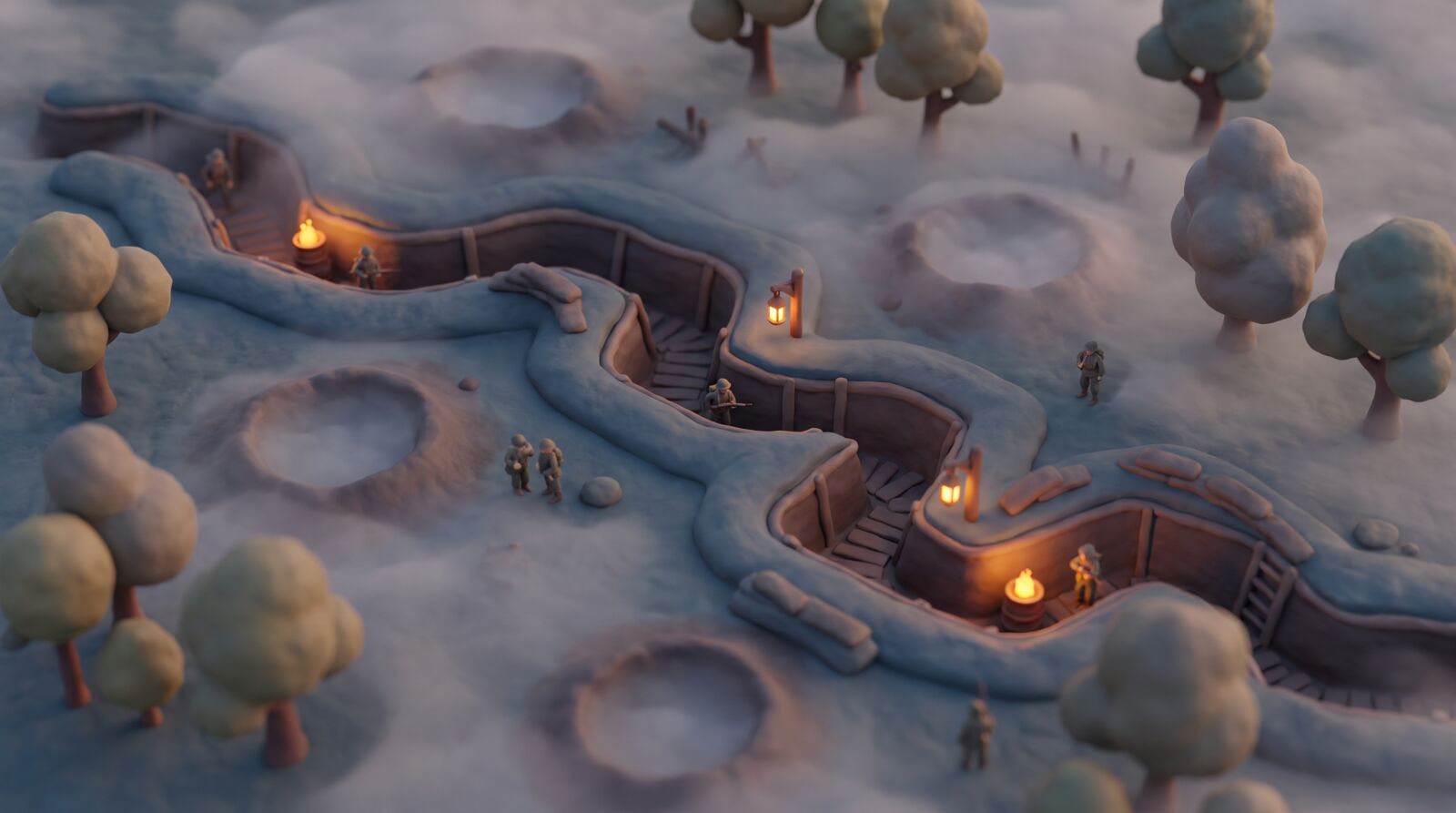
Each season opens a chapter, a handful of story operations at fixed places in the valley, and something new to learn. You reach them by rail, in the order you choose. A campaign runs 10 to 15 hours, and Valley Mode keeps the war going afterwards.
Tilly arrives; the front is about to break.
Cold, short days; letters from the villages behind the lines.
The Mustard Company enters; old friendships are tested.
Peace talks begin.
Painted while the game is being made, to show where Shellfall is headed. None of it is taken from the game yet; real screenshots will take its place as the war comes together.
Shellfall is still being made, and it starts with what matters most: a single shot that feels worth firing. Everything else is built on top of that, one step at a time. Here is where it stands and what comes next.
Now Working on: The shot updated 13 Oct 2026
Shellfall has a home on the web. Here is what the game is, how it looks, and the first thing being made: a shot worth firing.
Making a single shell feel worth firing: the heavy turn of the barrel, the boom, the long flight and the crater it leaves.
Armies that fight on whether you fire or not, with trenches, fog of war and recon.
Old Marta on the move, enemy guns hunting her, a first dig to cover and a first story operation, in the finished look.
The third army, all six shells, four seasons of story, letters and Valley Mode.
Polish, Steam Deck, accessibility options, a demo for everyone to try, then release.
After launch: one war for every player, on one shared war map.
One day you will be able to look in on the Lowmarch right here in your browser, painted live by the game itself: the same watercolour, the same fog, the same war clock.
Recon is developing the photographs…